My first thought when asked about oil and gas prices that are currently going through the ceiling was, Oh hum, so what? That is because I live on a small island and drive an older, manual shift motor-scooter. A 5 euro tank full lasts me more than a week; yet it was a 3 Euro tank full when I first came here a few years ago.
I saw a news headline that said California was over $3 per gallon the same day I read an Italian blog that said fuel there was $6 per gallon. So I did a few calculations converting litres to gallons and euro to dollars and came up with just over $4 per gallon here on Paros, Greece. So the world oil economy is not uniform yet. I wonder what gasoline is in Russia where they produce crude oil faster than they can transport it?
Yes, even on our island paradise we have to look at the big picture. When we first moved here many friends and relatives visited and we could come and go through out Europe for relative small amounts. Sometimes airfare between Athens and London was as low as 50 euro (then $60). Now we have fewer visitors and tourism is down mainly due to the higher cost of airfares, which of course are high because of fuel costs—not to mention security costs due to instability in oil-producing regions.
So my long term answer is to spend more time in virtual travel on my computer and less time burning up the highways and air lanes. Of course I have the advantage of modern batteries, wi-fi and VOIP to continue my work-at-home on the beach.
This article was first written on assignment for SearchWarp, an article distribution site.
If you like to write article style posts, another good place to publish them is WriteUp.
Gas Prices
wi-fi
VOIP
work-at-home
Greece is ever so slowly bringing their laws and culture into the modern times of the European Union. This note is from the news of a few weeks ago:
Lawmakers yesterday approved legislation allowing for the cremation of the dead to take place in Greece for the first time in country's history.
The law permits the cremation of people who request this method instead of burial as long as their religion also allows it.
The law still forbids the act for Orthodox Christians. The Church of Greece opposes cremation for believers, arguing that Orthodox traditions only allow for burial.
Another interesting matter is that sincecemeteryy space is at such a premium it is not uncommon in Greece to rent the plots for three years and then exhume whatever remains for placement in a common storage space called an ossuary. We have heard that some rural people rebury the bodies on their farms.
If you are a member of Blogazoo here is a Gazoo
If you are not yet a member; join here for blogging benefits. Blogazoo
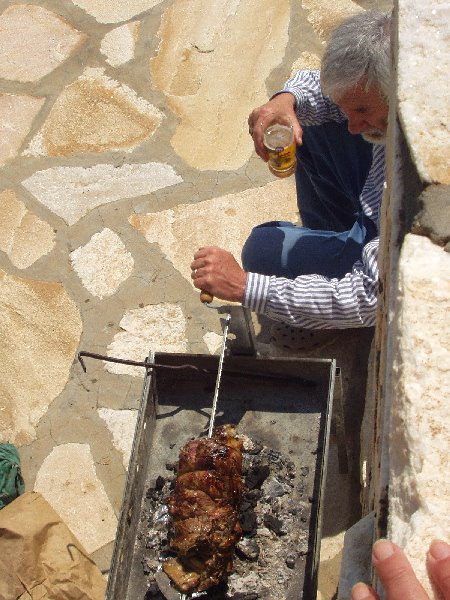
What a day. Too much!
To much food and too much wine. I went to bed early; before our guests had left in fact. Karin, always the perfect hostess, managed to stay up and see them all off. The next day, however, she was at half speed.
To much food even though my first attempt at barbequeing lamb--thankfully we didn't know which one from the field next door we were eating--did not produce anything edible until the next day. I blame it on the cooling effect of the island wind.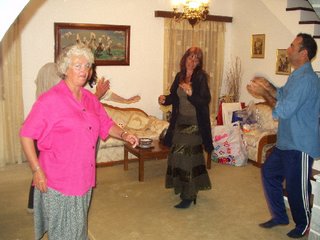
Just as we sitting down for our dinner (including thankfully some roast pork brought by one of the guests, Robert) Mathios, our neighbor and landlord arrived and insisted we all come to his house for food and wine. We promised him we would be up in 30 minutes. So using Greek time, an hour later we left to experience a Greek easter celebration--much toasting, much food, much music and dancing and did I mention much wine.
The only reason the evening ended was that Mathios had to milk his goats. Karin said, Poor Mathios; I replied, Poor goats.

Talk about timing! Saturday this poppy field was brilliant in the sun.
Monday when Karin took this picture it was cloudy.
Tuesday the field had been mowed.
We don't know what the farmer is harvesting?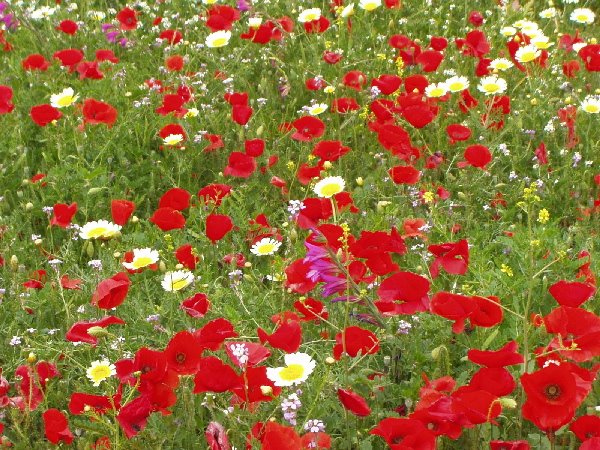
This is a close-up.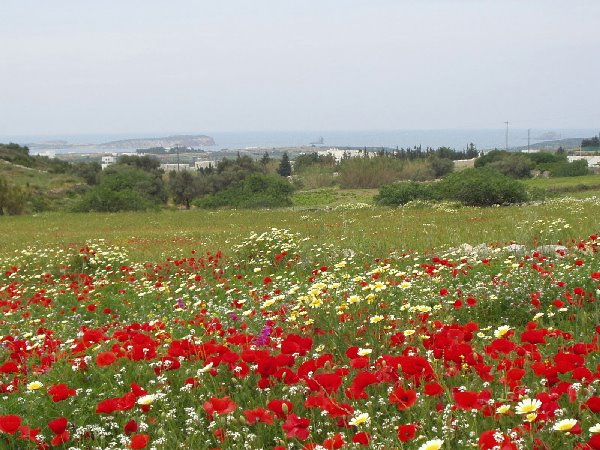
This is for perspective.
Last night we experienced a very interesting piece of Greek Orthodox culture: The Good Friday parastasis procession at Marpissa. This is a big event for the Easter holiday but I had not attended before mainly because I have little patience for events scheduled at 10:30 P.M. that don't start until well past 11.
This year, however, I decided to practice my patience and not have any expectations of timeliness and organisation. Yet when we were comfortably ensconced after dinner the thought of putting on our winter clothes to moped 30 minutes to the far side of the island had little appeal. I shamed myself into making the effort and was well rewarded. I don't think I had been there at night before and I was amazed how large the village was all lit up. Floating above it with an intervening dark space was the monastery of Agios Andonios , which is perched at the pinnacle of a steep hill.
Sure enough the procession came out of the church door about 11:15 and we shuffled along with the crowd past the first of many still life scenes from the passion and resurrection of Christ. The costumes were quite elaborate as well as brightly colorful. Normally the traditional Greek costume is much more subdued. In the course of a 30-40 minute walk through and around the village there are 10 to 12 scenes. Some of the actors take the easy way out of establishing comfortable postures of lounging or leaning on a shepherd's crook, but the principles seem to take pride in assuming a difficult-to-hold pose. All in all it was well presented and performed.
The major problem was that lighting was beyond the capabilities of my digital camera--or beyond the capabilities of my operation of it anyway. So we have no photos.
The culmination, but not the last, is the depiction of the Crucifixion. Three men are hanging from the three crosses surrounded by the soldiers, Mary Magdalene and others described in the bible. It does drive home the agony of the happening. We could tell the audience appreciated the entire presentation of bringing religious teaching off the printed page and into personal experience. By the way, I noticed there was a high percentage of young people in the audience, not just the elderly who normally attend services. There were not many children because they were in most of the tableaux.
We concluded after midnight with an ice cream at a busy shop and then headed home just as a small shower started. By the time we came around the South end of the island it was raining hard. Since April showers bring May flowers, I will show some flowers next post.

Crime has reared its ugly head in our neighborhood. Karin had her motorcycle helmet lifted from the basket on the back of her motor scooter (moped). We don't know if it happened while parked infront of the village supermarket or while sitting at home next to the street. Nevermind that she didn't like it and only wore it if she saw a police roadblock, someone took it. Now we have to be careful what we leave sitting while we pop into a shop or what is in reach of the street in our garden.
Whether it was a true thief or a child having a lark, there is only one conclusion: The world is going to hell in a hand basket!
If you are a member of Blogazoo here is a G a z o o
If you are not yet a member; join here for blogging benefits. Blogazoo
Recently we have taken a giant step to improve the situation with the establishment of The Apothiki Gallery. The founders, Dirk Drijbooms and Hilde Van Lindt from Belgium, have specific goals in mind. To quote them:
“An art center with an ‘easy access approach’, no ‘whispering gallery
atmosphere’, a meeting place for confronting ideas and perceptions, a
professional space for exhibitions and performances and last, but certainly not
least, a healthy creative inter-action with the local and international
community of Paros, artists and art lovers alike!
In other words the Apothiki Gallery over the last two years has not only hosted world class exhibitions it has been the meeting place of choice for any and every artistic event that it can hold. For instance the local association, International Paros Art Circle, is currently holding a very well attended series of discussions on Art Appreciation.
Another very attractive aspect of this art center is its residency programme. Again it is the ‘place of Paros’ that is the drawing card. Talented and renowned artists are encouraged to spend time on Paros not only creating but refreshing their soul. Once they have been here they become friends for life and our island environment is enhanced accordingly.
The gallery is hidden away between two narrow lanes in the old section of town. Prior to their restoration, the 600 year old buildings were used to store olive oil, wine and other ‘precious goods’ and were known by the local people as the apothiki. They have a very full and complete schedule for the 2006 season and are already accepting enquiries for 2007. Apothiki is a member of the worldwide network of Residential Art Centers RESARTIS.
Learn more at their web site and read about Paros Hospitality Art Workshops here.
artist residence
RESARTIS

While Karin is off photographing the wildflowers and other nooks and crannies I catch up on my reading. 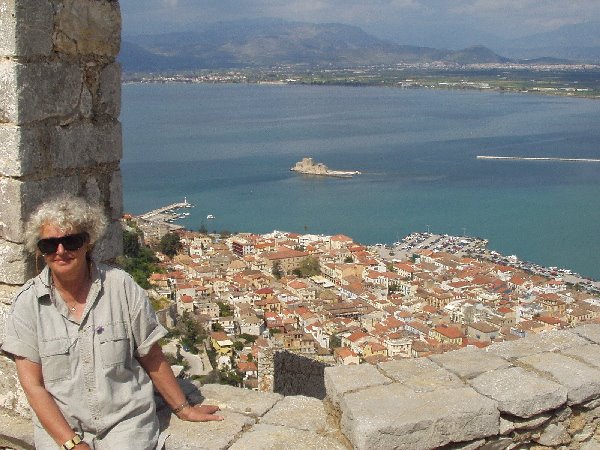
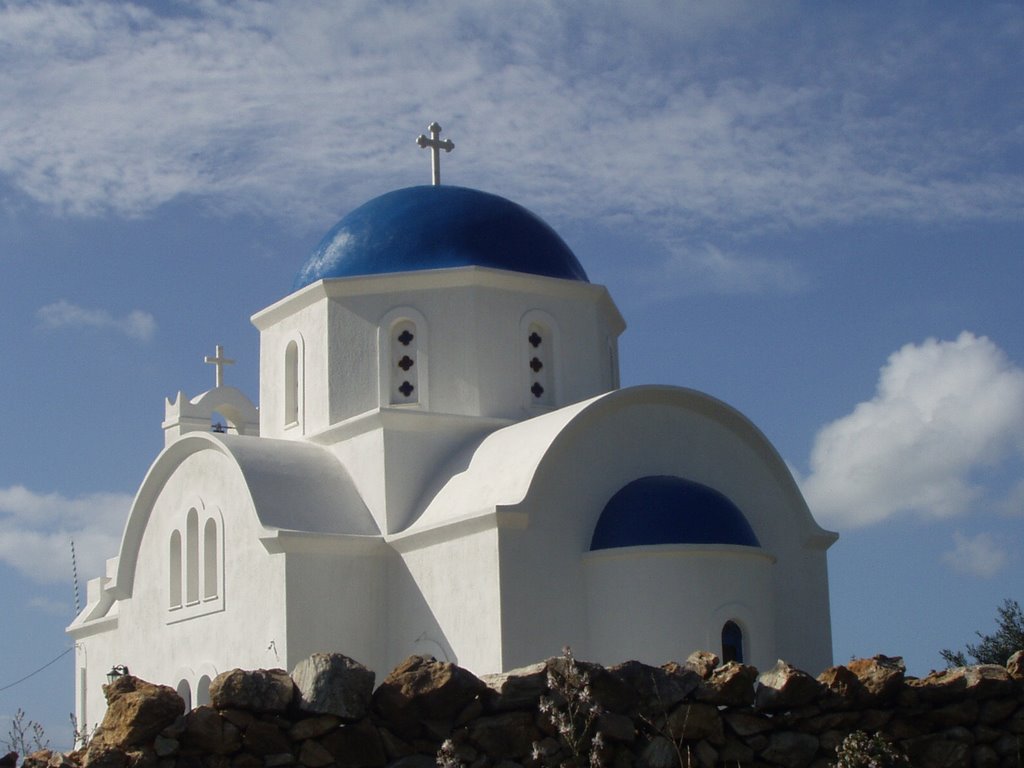
Happy Easter to all the Christian world that is not Orthodox. Today, here on Paros, is Palm Sunday; tonight at midnight Great Week starts.
To describe the highlights of a Greek Easter I will actually start at the end, the day itself. The church services are pretty much routine with most people at home preparing the roast lamb and other long denied foods for the large family gathering that will last the whole day and night—with occasional bursts of fireworks. The day starts just after midnight with eating mageritsa, a soup made with sheep guts. I have eaten it once and that will last me for a few years until my memory goes.
The other highlight of the day that we see evidence of year around is the burnt cross above every doorway, home and business alike. This is done with a candle that is brought back from the major Saturday night service in which all lights are extinguished than one holy candle is used to start the progressive lighting of everyone’s candles—an impressive and meaningful ceremony. Afterwards the common greeting is Christos anesti, Christ is risen, and the response, Alithos anesti, Indeed, he has risen.
There is much going on all day on Good Friday as the intensity has built each day of Great Week. There are services all day with a great many people (just as in other countries some Christians only make it to church one day a year) making the rounds of candle lighting and kissing the icons. The churches are still dressed for mourning but with the addition of huge amounts of fresh flowers. Here on Paros the three main churches in Parikia start their processions at about the same time then end all together at the town centre, the windmill, at about midnight. Again an impressive occasion as long as it is not too windy at the time. Not to be outdone the villages of Marpissa, Marmara and Prodomos hold their own elaborate processions and tableaux complete with costumes, donkeys and men tied to crosses.
The other notable part of Easter, of course, is the Lenten fasting for several weeks leading up to the final day. The rules are quite complicated and many young people today don’t know them; they just know there are some traditional foods that they only get during this season. The devout Orthodox are not allowed meat, animal products (eggs, cheese, milk), fish, oil, and alcohol. Also, by the way, no sex so as to better commune with God. You can see why some traditions are dying out. Some of the foods that are allowed are olives, rice, pickled vegetables, fruits, nuts, honey, and non-fish seafood such as octopus, which is quite plentiful here.
I have mentioned elsewhere how delicious the eggs taste here, but they lack something in originality as Easter Eggs. That is Greek Easter eggs are always red, that’s all, always red. Of course there is a tradition associated with this dating back to Mary and Christ. All I know is that the predominant symbol for Easter is a red egg; you see them everywhere.
I will conclude with a few words about the differing dates for Easter. The why is best left to church theologians and academic historians who will never agree on an answer, I am sure. It is interesting, however, that after the Christian churches split in AD1054 they celebrated Easter on the same date for about 500 years until the Catholics adopted the Gregorian Calendar. For the most complete treatise and numerous algorithms on this see M.J. Montes web site at
http://www.smart.net/~mmontes/OrthEasttbl.html#T3
Or just use this chart from http://users.chariot.net.au/~gmarts/eastcalc.htm
WESTERN ORTHODOX
~~~~~~~ ~~~~~~~~
23 April 2000 -- 30 April 2000
15 April 2001 -- 15 April 2001
31 March 2002 -- 5 May 2002
20 April 2003 -- 27 April 2003
11 April 2004 -- 11 April 2004
27 March 2005 -- 1 May 2005
16 April 2006 -- 23 April 2006
8 April 2007 -- 8 April 2007
23 March 2008 -- 27 April 2008
12 April 2009 -- 19 April 2009
Now you can see why we spend a good deal of time comparing and contrasting our life on a Greek isle to what we know elsewhere.
Much of my information comes from an article by Katherine Clark that appeared in Paros Life, April 2006
This should be of interest to travellers between the U.K. and Greece.
The news has just come out that Kosmar Holidays has been acquired by Excel Airways Group.
Kosmar is a leading specialist in travel to Greece while Excel has been expanding its number of charter flights to various Greek destinations. In season they have flights to Mykonos and Santorini for easy ferry transfer to Paros. Kosmar maintains an office on Paros as well.
This is the link for more details of the acquisition:
http://www.traveldailynews.com/new.asp?newID=29081&subcategory_id=53
Check out Excel’s flight schedule here: http://www.xl.com/
And for a delightful virtual tour of Greece check out Kosmar’s site: http://www.kosmar.co.uk/
I love their opening description:
Have you ever dreamt of a holiday paradise with unspoilt beaches and
crystal-clear seas, where lazy, sun soaked days are followed by breathtaking
sunsets and warm, laughter filled evenings mellow into starry, starry
nights?
Kosmar will make your dream a reality!
Their description of Paros is excellent:
Paros is in many ways the perfect example of a typical Cycladic island.It's
lively and attractive capital port of Parikia is a maze of winding streets
(deliberately designed to confuse invading pirates long enough for the islanders
to escape) which are now full of fascinating shops, smart restaurants and
tavernas, and busy music bars. Around the coastline there are numerous wonderful
sandy beaches with safe swimming in warm clear waters, and Paros is large enough
to keep you busy exploring by hire car or local bus for several days, before you
turn your sights on trips to neighbouring islands. The closest is Antiparos, a
tiny satellite island just across the water from Parikia, with another superb
sandy beach and a little resort village of its own. Further afield, depending on
the time of season and inter-island ferry timetable, it's possible to visit
Naxos, Ios and even the dramatic volcanic beauty of Santorini. Rather quieter
than Parikia is the beautiful village of Naoussa (pronounced Now-sah), set on
its own bay some fifteen minutes north of town by bus. There's a
eucalyptus-shaded square, and a tiny fishing harbour surrounded by fresh fish
tavernas which will have you reaching for your camera every five minutes!
Naoussa has its own shingle and pebble coves, with windsurfing out in the bay.
Nightlife in Naoussa is fairly laid back, with some friendly music bars and a
couple of discos, (although it gets quite busy in July and August), and for more
action, Parikia is just a short bus or taxi ride away. If you have a hire car,
or you're a keen walker (allow 30-40 minutes) you'll find long stretches of fine
yellow sand at Santa Maria and along the peninsula to the north. Other great
beaches can be reached by buses from Parikia over to the east coast village of
Piso Livadi, and Chryssi Akti (Golden Beach). For an all-round holiday with a
good selection of things to see and do, fine sandy beaches and lively nightlife,
we can definitely recommend Paros - it's what Greek island holidays are all
about!
So while I recommend both Excel and Kosmar to get our personalised view of Paros see: http://ParosParadise.com

I seem to be having writer's block about our recent 3-day trip. It was a great time; we saw a Greece that we had not seen before; it was relaxing and busy at the same time.
There, what more can I say? Hopefully Karin will do better in her evocative style.
This first picture is through one of the windows in Palimiri Castle above Nafplion in the Peloponese.
This snapshot was taken at the outdoor flea market near the Monastiraki Metro station in Athens.
We say Paros has something for everyone. This booth certainly does.
See our island photos on our web site. Mostly at the Gallery page.
If you are a member of Blogazoo here is a Gazoo
If you are not yet a member; join here for blogging benefits. Blogazoo
Karin and I went for a three day holiday and it is taking me three days to catch up on work. I will write more as we prepare the photos. For now let me say the first highlight was seeing a group (is that pod?) of dolphins skipping through the waves. It only lasted a few seconds and no one near us was able to get photos. Although we had experienced the famous Fungy in the Dingle Bay in Ireland, these were the first dolphins we have seen in our 6 years of living on a Greek island. Yet the tourist bureau claims they are common and their likeness is often used in advertising.
Paros did receive some international publicity lately. Just last week several antiquities were discovered--in the Paros villa of former Getty Museum curator Marion True. This was a follow-up to her losing her job for borrowing the money for the villa from a Getty Museum supplier of antiquities. We don't know where her villa is but it must be something special as she paid $400,000 for it in 1995 when prices were a quarter of what they are now. We can only hope she covers some of her legal expenses by opening her home to the public--hehehe.
More details at: http://www.iol.co.za/index.php?from=rss_SciTech&set_id=1&click_id=&art_id=qw1144067401708B262
I think everyone who has been to Athens has a love/hate relationship with the city. What I find most uncomfortable is the sidewalks/footpath's. They are usually broken and in disrepair. There is little point in fixing them, however, because they are always blocked by parked vehicles anyway.
Here is an editorial lifted from Jayne: Visit www.asimenia.com join Gadzooks! newsletter or browse Asimenia Jewels!
Life will soon get very difficult for the tens of thousands of drivers who park their cars on sidewalks, creating insurmountable obstacles for any pedestrian who dares to actually try using those walkways.
Right now, the situation is dire. Mothers pushing children in strollers are frequently forced to walk along the road next to passing vehicles. Elderly people must keep climbing on and off the curb. Pedestrians must weave between buildings and cars on the sidewalks, even at intersections.
And what about the nightmare endured by people with disabilities who are bold enough to try getting around Athens in their wheelchairs?
One wonders just how long this miserable situation will be tolerated, since it consistently endangers people’s lives. The indifference on the part of the authorities is astonishing, as is the outrageous tolerance on the part of the traffic police.
Inspections, if they take place at all, are few and far between, and fines for parking on sidewalks and pedestrian crossings are so paltry that they actually encourage people to disregard others’ interests.
Add to that the outrageous lack of coordination between authorities, local government and the ministries in managing what is really a fundamental problem in the capital. This failure has only made it all too clear that the state has failed to do its job.
Government ministers are always talking about improving the quality of people’s “daily lives,” yet they do do not realize that even their efforts encouraging people to use public transport will be fruitless if pedestrians cannot walk around the city without the stress and danger of too much traffic.
Let’s hope that the just-announced citizens’ incentive to establish a movement, including “people with an awareness of viable means of mobility, transport and quality of life,” will be enough to mobilize the authorities, who have so far been indifferent to the plight of so many.
We have had a few warm days--I am guessing 62-63F/17C--and everyone is talking summer. I took off my middle layer of clothing and still felt warm. Our friend, Ron, went swimming. He did say it was bracing!
Karin and I have a bet whether we will have any more rain, defined as heavy clouds and 15-20 minutes of rain. I say yes, she says no. We wagered a whole two ouzos. That's big for us; we play a week's card games for one ouzo. Though I should confess Karin gives me a handicap on our nightly card game. If she wins I buy ouzo; if I win she buys dinner.